Objects by Ukrainian designers
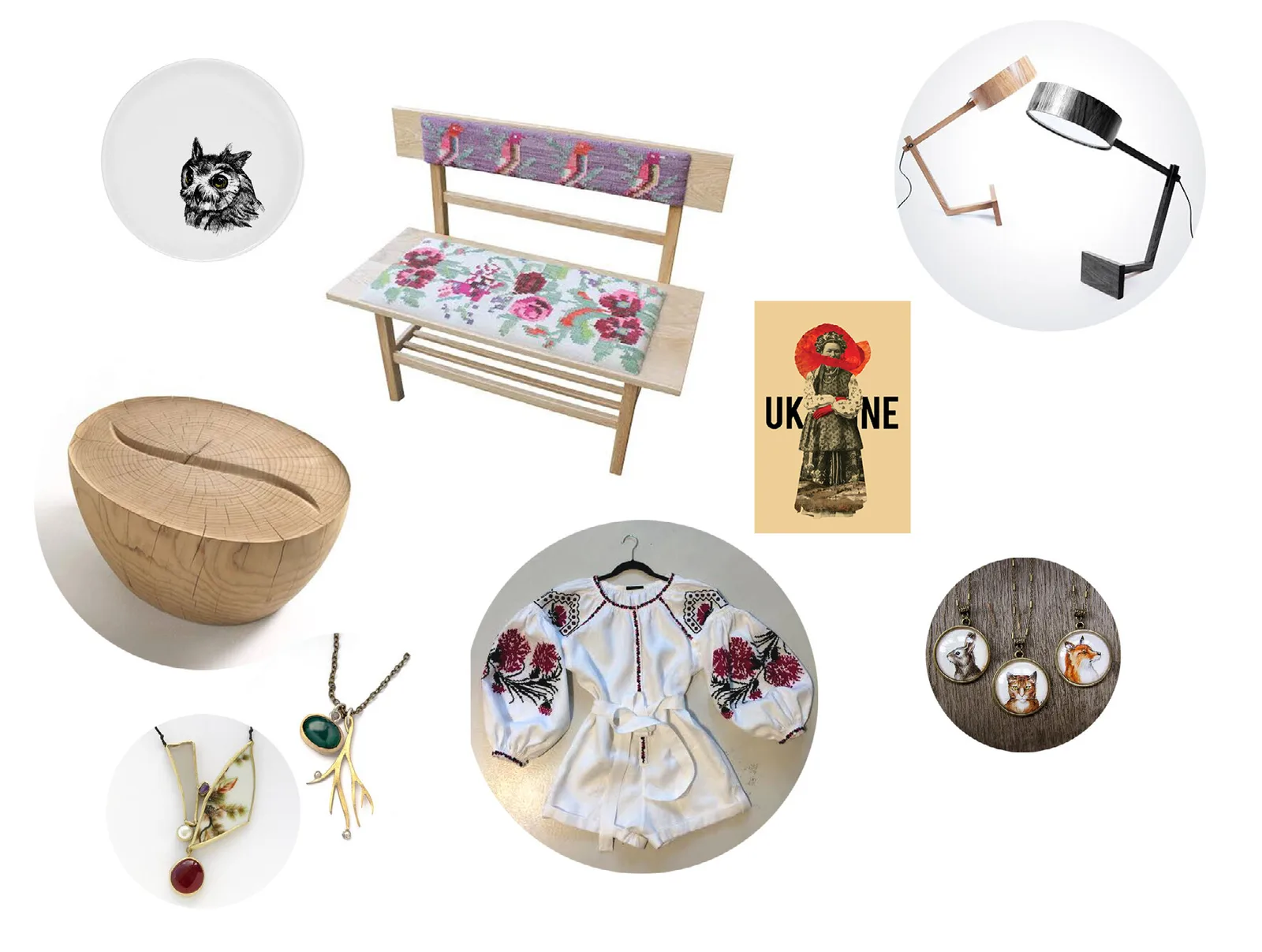
Our collage is a message about inspiration. Look at the work of Ukrainian makers — it is excellent: unusual, poetic and at the same time very inventive, with a character of its own and its own attitude to the world around it. This is exactly the kind of design that lives beyond a magazine selection, that can travel, that you work with and fall in love with, and that, quite simply, can live in and shape any environment.
My favourites: AbraKadabra jewellery, which doesn’t dazzle you with diamond sparkle at all but can speak of something tied to the character of the designer and the individuality of its future owner; Vita Kin’s vyshyvankas — clothes with a high concentration of femininity, in which it is so easy to become someone’s dream; and Maiia Kostelnytska’s jewellery, with its special sensuality and its precise aim at femininity.
Olena Yudina,
designer, decorator, architect
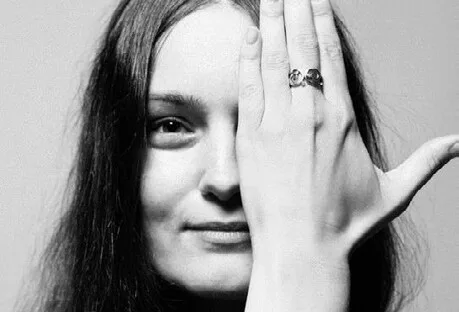
Liza Portnovaand Andrii Kyrychenko
interview: Olena Yudinaphotos: Yuliia Hekhman
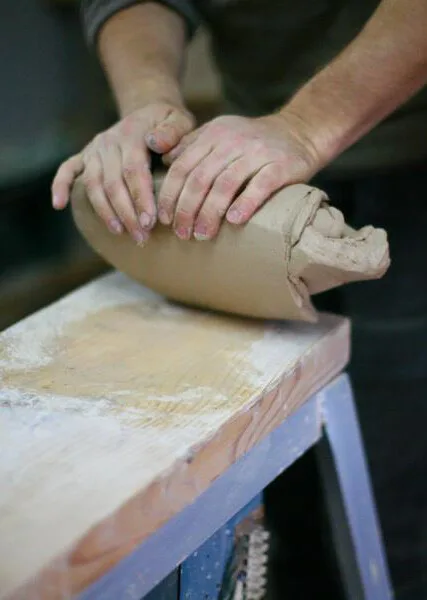
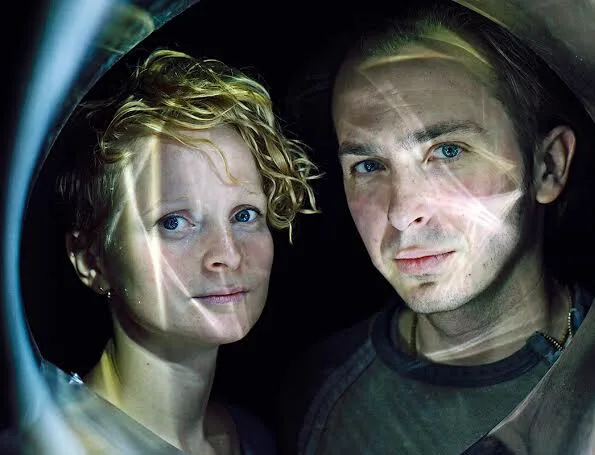
When did you decide to become a ceramicist?
Liza: The borders of my immersion in the alluring, unpredictable, all-absorbing world of clay — the “before” and the “after” — are impossible to draw. But I can say with certainty that it was love at first sight, and it grows stronger and stronger with every new piece.
Do you remember your first ceramic piece?
Liza: Of course I remember my first piece. And of course it didn’t come off — I think that’s normal in any art — but the process itself drew me in, and that’s what matters. If you work only for the result and close your eyes to the process, you are unlikely to get anywhere. Clay reacts instantly to your mood and demands constant attention. And one more thing: every clay body has its own character, and you have to reckon with that too. That character will show itself regardless of your wishes. Be ready for it. What matters is not the first piece but the first sensation, which stays with you forever.
What in your work gives you a sharp sense of joy?
Liza: The very sharpest feeling is probably that futuristic sense of tremulous joy when, waiting for a miracle, you open the kiln and, like a tiny person, peek into an unknown galaxy of another universe, trying once again to grasp or touch the nature of the elements, whose behaviour is so polyphonic and so whole.
At that moment you can “hear” your piece as a whole and grasp that it is complete. The kiln plays the final chord. Firing is my co-author: its hand is the last to touch the piece, which is why unloading the kiln is always a sacrament.
What qualities does a person need to make it as a ceramicist and be in demand? How can they tell they have chosen the right profession? Is there an age after which it is too late to start?
Liza: Traits such as perseverance, self-control, endurance and resilience should not be alien to a ceramicist. And strength of spirit and strength of body too. A readiness to give all your time, thoughts, health… In other words, everything that is the faithful companion of obsession, because obsession is the main ingredient of the profession.
Being in demand and being a professional ceramicist are not always the same story. A lot depends on which direction of ceramics you work in. Following the path of demand, it is easy to lose your “form” in the profession. Our profession requires constant searching and discovery. Which means it cannot stand great speed and requires you to keep listening to yourself. Every discovery is followed by adaptation. All of this takes time. It’s like a newborn that finds it hard to come into the world on its own. All this carrying and adapting of the new takes time, and demand takes that time away.
As for the right choice: it is never entirely clear whether you choose your calling or it finds you. The only certain thing is that without your work, without your craft, you can neither breathe nor live. To me that seems convincing proof that the choice was right.
I don’t think age can stop you from loving ceramics and working in it. It’s hard for me to be objective about this, since I have been in ceramics since early childhood, since my school years. But even if such age limits did exist, should you let them stop you?
“It is never entirely clear whether you choose your calling or it finds you. The only certain thing is that without your work, without your craft, you can neither breathe nor live.”
Which schools in Ukraine and abroad train strong ceramicists? Does Ukrainian ceramics education have its own features, pros and cons? How do they show?
Liza: Ukrainian schools lay a certain foundation that serves as a support for self-development. That’s good. But at the same time they set a vector, a direction, a trajectory, and that is already harmful to an artist’s formation. In any case, an education system is only a set of circumstances in which you meet certain tasks and have to solve them. Whether those circumstances are favourable or hostile, everyone decides for themselves. But no artist is formed without them.
And who influenced you creatively? Who inspires you?
Liza: Without naming names, the artists of the Expressionist era. Artists who weren’t shy of their “own” brushstroke and paid no heed to prejudice. Free artists. It’s hard to create something new in captivity… I can’t avoid mentioning Van Gogh: his path can’t fail to inspire. Gauguin’s life is admirable too. And all of Africa, from the Sumerians to the present day, with its ancient and wild civilisation, and Mexico.
Where do you get your information about design and art?
Liza: My source is the internet. Lots of groups, informal organisations and communities. Personal subscriptions to bloggers who put together distinctive selections. Here’s a good page on fb with excellent work: Céramique-Contemporaine.
Whose work do you follow yourself?
Liza: It’s not so much following particular makers as following the movements that arise in contemporary ceramics, which takes its start from satori. Those movements that talk about the “ceramicness” of ceramics, however strange that may sound. After all, ceramics is not just something made of clay but something that reveals the nature of this material.
Who gave you the best advice you’ve used in your work? What was it?
Liza: I was lucky: I was surrounded and shaped by the most talented artists — Volodymyr Hurin, Iryna Borysivna Spornykova, Oleksandr Shafirov, Gia Miminoshvili. I am grateful to these people for inspiration and creative support. There is no single piece of advice I could single out as life-changing. Rather, it’s thoughts dropped in passing in conversations about everything. An artist is not someone whose work shift ends, after which they stop being an artist and turn into someone else. With such people you can talk about anything, and in any conversation, even an everyday one, you are talking first of all with an Artist. Brewing coffee or scenting a room with fir needles — the things that make up the daily life of “remarkable people” — can give the world a different idea of things.
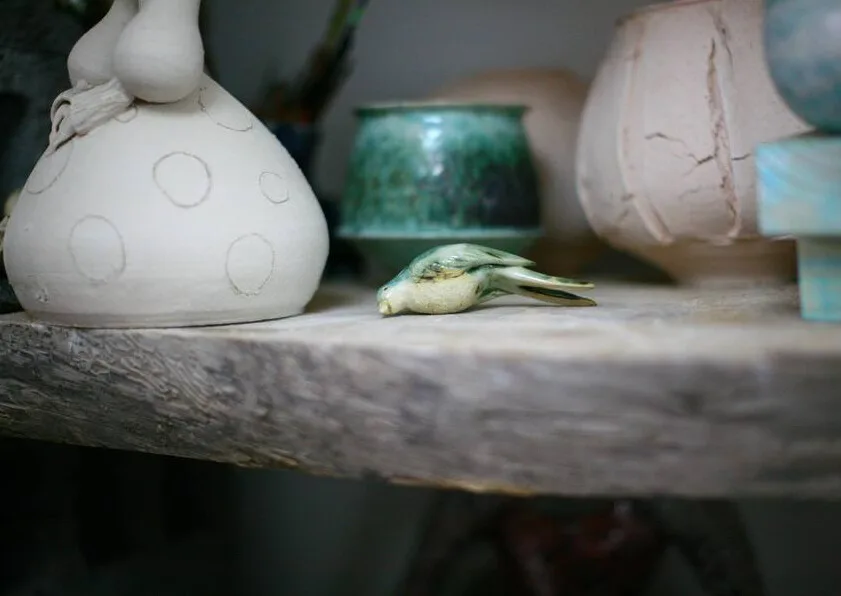
Liza, you don’t work alone but with Andrii (ed.: Andrii Kyrychenko), and your pieces are sometimes made together with him. How are the roles divided, and how is the process itself split between the two of you?
Andrii: Yes, that’s our sin (laughs). It’s hard to say now who “picked up” whom and who “owes” whom. But I can say for sure that I do ceramics precisely thanks to Liza. For me ceramics was and remains one of my main means of expression, one of the peepholes in a door behind which lies “something sought”. Whereas for Liza ceramics is a way of life. Her obsession pulled me into this “river”. We’ve known each other since childhood, since art school. And while I was “serving” my six years at university studying electronic engineering and circuit design, Liza was diligently getting an art education at the Industrial College. As a result, in our tandem she is the only person officially versed in the processes we work with. Later we crossed paths again as “educated” people, and since then our union has given each of us a great deal.
Ceramics has a rather jealous nature, and if your partner is busy with something else, there’s a good chance that “Bolivar can’t carry two”. Ceramics involves a lot of “ploughing” that sits badly with the creative process, but that “ploughing” is a must. And that’s my lot, 55% of it. The wood and metal that find their place in the pieces are me too. But all the glaze, all the painting, everything that can breathe life into our work, is Liza’s handiwork. Often some nuances of an authored piece are decided “as a duet”: “Can you come over and give me advice?” and so on. Of course, in such cases the authorship isn’t pure. Lately we’ve become more responsible about this, dividing things into “yours” and “mine”.
Not only because “exhibition etiquette” demands it. You develop your own “language”, your own vision. In many ways our view of and approach to ceramics differ greatly, and in such a contradictory duel of a relationship it’s easier to settle into your own “delusion” and follow it. We are teachers for each other.
Does your work have a particular overarching aim?
Liza: Yes, of course. It’s the path to yourself. Can that path be completed? I don’t know. But the path itself is already the overarching aim. By discovering something new, we let our world transform and gain new possibilities of harmony. A world in harmony is the world we strive for, and the goal of the path to yourself. Perhaps it’s all about perception, which working with ceramics keeps adjusting. In my case, working on my own perception is work in the literal sense. Following that logic, doing ceramics means changing the world.
What motifs or images run through your ceramics and are celebrated in it?
Andrii: It’s worth separating the form and the content of a piece; that lets you answer the question more precisely. The “image” is a variable component, while the content, which is what the work is mainly about, remains the constant priority. Ceramics should first of all be “ceramic”. It can imitate a huge number of materials, revealing the palette of its possibilities. But it has qualities that belong to it alone in form yet echo something else in essence: plasticity, fragility, sharpness and so on. Projecting these qualities onto images creates a different, “ceramic” view of the world. When you work in that key, the image doesn’t matter; motifs take on a new timbre. Each new interpretation of an image gives it a new life. Such variations are interesting.
“A world in harmony is the world we strive for, and the goal of the path to yourself.”
If I try to single out the image it feels most natural to turn to in the search, it is the image of a kind of fruit. Its origin doesn’t matter. Every fruit goes its way from seed to withering… Its ripening, its exchange with its surroundings, youth, ageing — all of this makes up a mass of textures reflecting the essence of any cycle, which ceramics expresses easily as it yields to the artist’s hand. The ceramicist in this case is the habitat, the conditions in which the fruit ripens and the work happens.
What nuances come up when you produce interior or exterior ceramics together with architects and designers?
Andrii: Ceramics is quite a lengthy process, technologically tied to timelines. Nowadays, when building a house from a finished design can take a few months, making a fireplace, for example, can take just as long. If a complex renovation of a house can happen in a single season, ceramics can’t keep up with that.
You have to separate ceramics that fill an interior or exterior (planters, fountains, structures of standard modules and so on) from ceramics that directly form the backbone of a space (elements made individually to fit architectural decisions whose dimensions are fixed and allow no trimming). Of course, in that situation it’s easier to pick a solution from a catalogue or turn to standard modules that give an acceptable result. Otherwise, if the scale of the project lays claim to uniqueness, the ceramicist must be involved from the very beginning. Their experience and understanding of the material can help even at the stage of designing the load-bearing structures. Such collaboration is hard work for both sides, but it is aimed at a shared result.
I’m sure such collaboration matters not only for ceramics, and I suspect such teams already exist in Ukraine. To answer the question, here’s a comparison: before a musician plays their variation on a theme, the orchestra has to play it as one team. Then the improvisation sounds in the key of the whole piece.
Who are your friends in your industry, your field?
Ceramics can take in any kind of work — the maker as well as the seller — because as a field it has many niches.
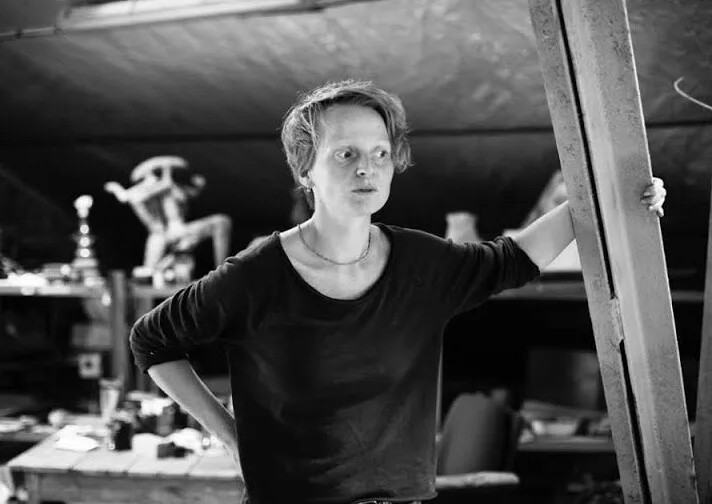
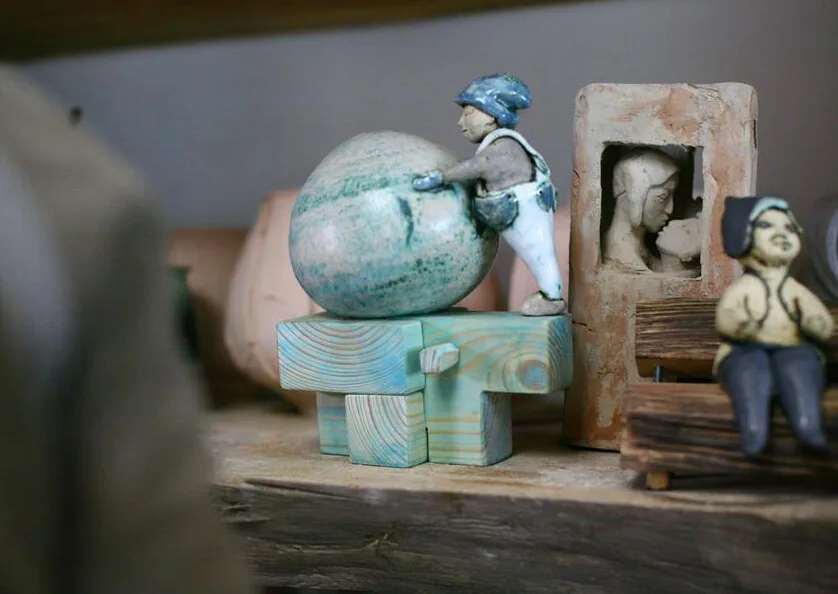
“Beauty is the sought-after and inherent quality of all that exists”
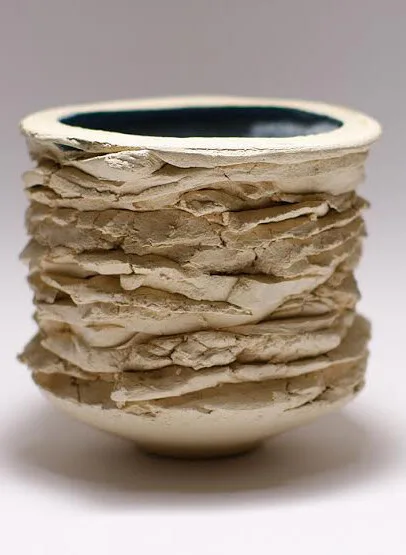
Our family is the people whose work is close to ours. After all, we’re digging the same mine, cutting the same canal, using the same lock picks. Taking over the initiative from one another, we still work as one team: each in our own studio, in our own country, but in one world. It’s always nice to meet someone from your own planet. Among our friends there are people from other planets too. But we — those involved in ceramics — make up its shared immune system.
Do you prefer classical or contemporary art?
Liza: Both classical and contemporary art pursue the same goal and have their own “excesses” and their own revelations. Contemporary art often borrows both form and content from the classics. And the classics are not always behind contemporary art in topicality and far-sightedness. Newton’s laws still work, side by side with quantum physics. So a symbiosis is acceptable.
Finish the sentence: “Beauty is…”
Liza: “Beauty is the sought-after and inherent quality of all that exists.”